


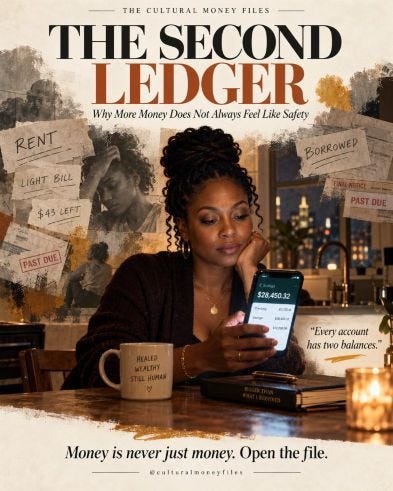
One of the strangest parts of building wealth from scratch is that money and anxiety do not always move in opposite directions. We tend to believe that as one rises, the other should fall. More money should mean less fear. A larger savings account should mean more ease. A better salary should mean better sleep.
But for many people who began with very little, both can rise together.
The balance increases. So does the vigilance.
From the outside, it can look like stinginess. Ingratitude. Overthinking. A confusing inability to relax.
But it is often none of those things.
It is the second ledger.
Every account has two balances.
The first is the number the bank reports. It is current, precise, and indifferent. It tells you what is there.
The second is the one you carry inside you. It is less exact and almost never current. It is written in the language of what it took to survive: skipped meals, borrowed rent, overdraft fees, shutoff notices, declined cards, and the quiet panic of realizing there is no one to call for help.
The first ledger knows what you have.
The second ledger knows what you went through to get it.
When you build wealth from scratch, the first ledger updates every time money moves. The second ledger often updates slowly, if at all.
That is why you can have a real emergency fund and still feel, in your body, as if you are one difficult week away from the envelopes on the kitchen table.
The gap between those two balances is often where the anxiety lives.
When survival outlasts the emergency
Researchers Sendhil Mullainathan and Eldar Shafir have written about the way scarcity captures attention. When money is tight, the mind narrows around the gap. You become highly alert to what is missing, what is due, what could go wrong, and how quickly everything could fall apart.
That vigilance can help you survive.
It can also follow you long after the immediate emergency has passed.
A mind that spent years watching for the next shortfall does not automatically relax because the numbers finally look better. No one sends an official notice saying, “You are safe now. You can stop checking.”
Financial psychologists Brad and Ted Klontz use the term “money scripts” to describe the beliefs we absorb early about earning, spending, saving, giving, and security. One of those patterns is money vigilance: being intensely watchful, private, and anxious about finances.
Vigilance can build savings.
It can also keep the internal alarm sounding long after the fire is out.
That does not make the second ledger a flaw. It was once an accurate record. It may have protected you. It may be part of the reason you learned to save, plan, work hard, and prepare for what other people dismissed as unlikely.
But it may still be using old numbers.
Why earning more can make fear louder
If the fear were only a memory, time might soften it.
But building wealth from scratch often brings new pressure at the same moment the old pressure is supposed to disappear.
There is more to lose.
When you had almost nothing, there was very little to protect. Now there is. Savings. Credit. A home. A career. A retirement account. A reputation for being responsible. A life that took years to build.
And if you remember exactly what it felt like to have nothing, the possibility of losing what you have can feel enormous.
There may also be no safety net beneath you.
For many first-generation wealth builders, there is no parent who can quietly cover an unexpected bill, co-sign a lease, offer a spare room, or absorb the impact of a layoff. Often, you are the person others call when something goes wrong.
Your savings are not only your cushion.
They may also feel like the family emergency fund.
Then there is the visibility of success.
As income rises, people notice. Sometimes they celebrate you. Sometimes they assume you are available. New asks appear. New expectations form. New judgments arrive about how you should spend, save, give, dress, travel, invest, or help.
You are managing a budget, but you may also be managing a reputation.
And moving upward can be expensive in ways people rarely name.
There are the professional clothes, the networking dinners, the wedding gifts, the travel costs, the memberships, the conferences, the expectations of certain rooms. There is the quiet cost of trying to belong in spaces your family may never have entered.
That is part of what I call the Mobility Tax.
You earn more, but you also encounter more exposure. More responsibility. More people depending on you. More ways to lose status. More proof you feel pressured to provide.
The second ledger is not irrational.
It is responding to real risk.
It is simply pricing that risk in the currency of an older, harder life.
What it can look like
This is a composite example, not one person’s story.
Over six years, Dana’s income nearly doubled. She has eight months of expenses saved. She is the first person in her immediate family to own a retirement account.
By most financial measures, she is doing well.
Still, she buys the store-brand version of almost everything. She has used a phone with a cracked screen for more than a year. She keeps a few hundred dollars in cash in the freezer, just in case.
When her sister needs $1,200 for a car repair, Dana sends it within the hour.
When Dana considers spending $1,200 on a professional certification that could increase her own income, she thinks about it for four months. Then she lets the enrollment window close.
This is the second ledger at work.
It approves emergencies quickly because emergencies are familiar. It knows how to respond when someone needs help. It understands that money can disappear overnight.
But it hesitates around investment, rest, ease, and growth. In its records, money that leaves may never come back.
Dana is not bad with money.
In fact, she is very good with it.
She is operating a highly sophisticated survival system that was built for a different set of conditions. The problem is not that the system exists. The problem is that no one has told it the conditions have changed.
A gentler next step
The goal is not to erase your second ledger.
It kept you safe.
The goal is to read it more clearly, so it can inform your decisions without quietly making all of them for you.
Write down both balances. On one line, write the number your account shows. On the next, write how that number feels in your body and in your mind. Does it feel safe, fragile, temporary, guilty, exposed, or never enough? Naming the gap turns vague dread into information.
Ask which year you are checking from. When you open the app for the third time, pause. Ask yourself whether you are responding to today’s reality or to an earlier season of your life. “This is the winter the lights went out” is easier to meet with care than “Something bad is going to happen.”
Set your support capacity while you are calm. Decide what you can reasonably give to family, friends, or community over a month or a year without putting your own stability at risk. Then a request becomes a budget question, not a referendum on whether you are loving, loyal, or generous enough.
Create a small proof line. Give yourself a modest amount each month that you can spend without an internal audit. It might be a meal, a class, a replacement for something broken, or a small pleasure. Let the second ledger watch money leave and watch your life remain intact. New records need new entries.
Separate growth from danger. Before saying no to something that could support your future, ask: Is this risk present, or is it remembered? A financial planner or financial therapist can help you sort through that question without shame.
The number is the same
It is Tuesday night again.
The number in the app is still the same number.
Maybe this time, you open it once instead of three times.
Not because the fear has disappeared, but because you have started to recognize the handwriting.
You know who wrote those entries.
It was a younger version of you, doing careful math at a kitchen table with far less than you have now. That person had every reason to be afraid. That fear may be part of why the number exists at all.
People will continue to see the savings.
That is fine.
The work now is to see the memory, too. To thank it for what it protected. To let it know that it does not have to keep all the books forever.
If this gave language to something you have carried quietly, subscribe to The Cultural Money Files. And if you keep a second ledger of your own, reply and tell me what is written in it. Replies come straight to me.
