


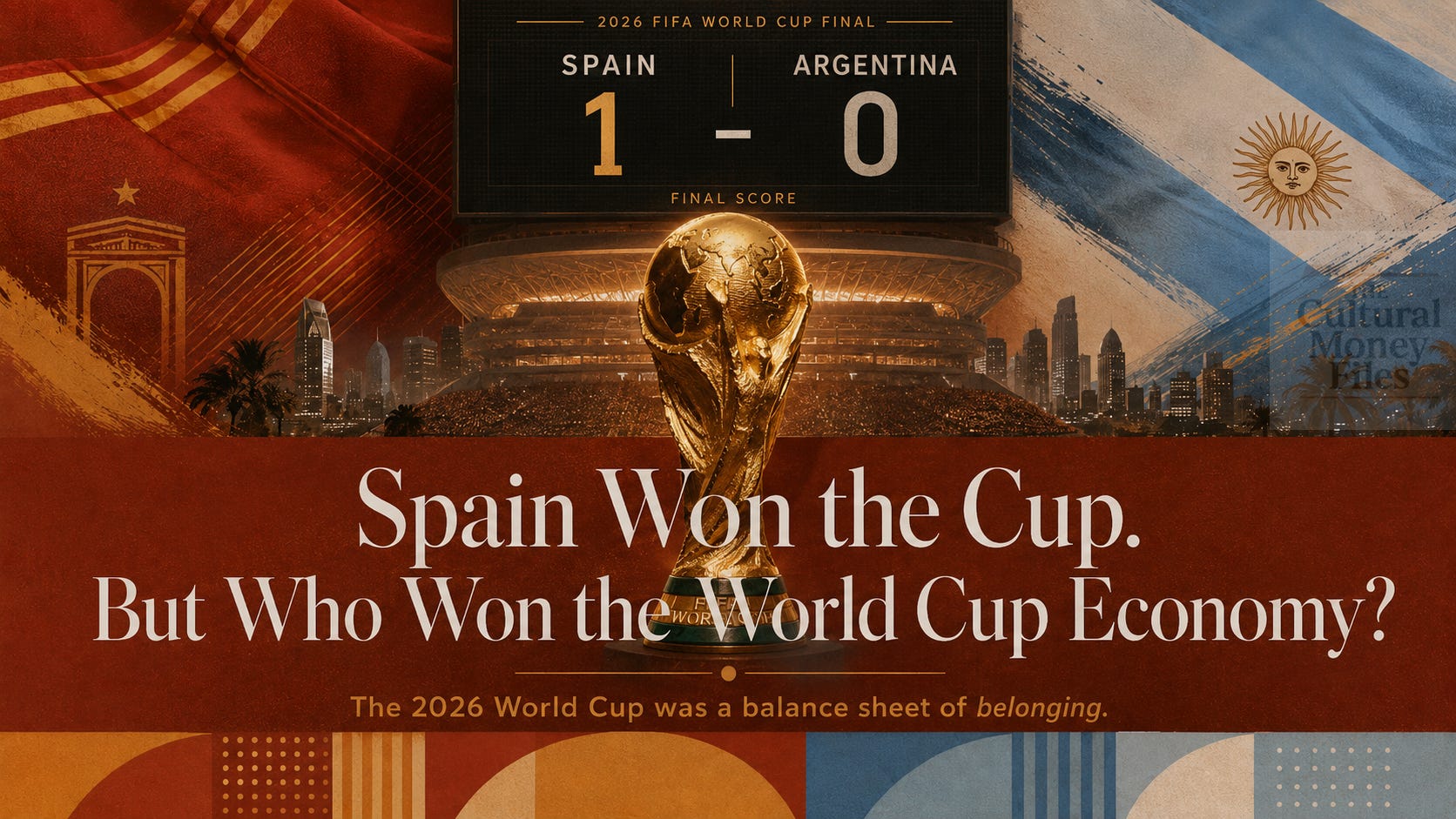
Spain lifted the World Cup trophy in New Jersey after defeating Argentina 1-0 in extra time.
For football fans, it was the conclusion of a historic tournament.
For Argentina, it was the painful end of an era that had been built around Lionel Messi.
For Spain, it was confirmation that one of the most successful football systems in the world had produced another generation capable of winning.
But through the lens of The Cultural Money Files, the final score is only the beginning of the story because the World Cup was never just about football.
It was about culture, migration, national identity, access, labor, inheritance, visibility and ownership.
Millions of people brought their flags, songs, languages, family traditions and national pride into stadiums, airports, restaurants, public squares and living rooms.
Corporations, governments, sponsors, broadcasters, ticketing platforms and football institutions converted those emotions into economic activity.
The fans supplied the culture.
The institutions owned the transaction.
That is the real World Cup economy.
Spain did not simply win. Spain demonstrated the value of a system.
Ferran Torres scored the winning goal in the 106th minute, giving Spain its second men’s World Cup title. Spain conceded only one goal throughout the entire tournament, and its victory made the country the first nation to hold the men’s and women’s World Cup titles at the same time. Amazing!
There were stars in the Spanish team, but the victory was not built around one irreplaceable personality.
Spain’s goals were spread across the squad. Substitutes repeatedly made decisive contributions. The team maintained its identity even when individual players changed. In the final, Spain controlled more than 65 percent of possession, completed more than twice as many passes as Argentina and produced 12 shots on target.
This is what a functioning system looks like.
It does not mean that individual talent is unimportant. It means the institution is not destroyed when one individual is unavailable.
That lesson extends far beyond football.
Many families are building their financial futures around one high earner.
One person knows where the accounts are.
One person pays the bills.
One person runs the business.
One person understands the investments.
One person carries the family’s professional reputation.
One person has the relationships that open doors.
From the outside, this can look like success. But when all the knowledge, access and responsibility are concentrated in one person, the family does not yet have a wealth system. It has a dependency.
Spain’s triumph offers another model.
The knowledge was distributed.
The style was understood.
The younger players had been prepared.
The substitutes knew what to do when called.
The structure was stronger than any one personality.
Talent can create a remarkable season.
Systems create continuity.
The final was also a story about inheritance.
On one side stood Lionel Messi, one of the most decorated players in the history of football, approaching the end of his international career.
On the other stood a Spanish team filled with players who may carry the sport into its next era.
Every family, business, institution and country eventually reaches this moment.
The person who carried the dream will not carry it forever.
The founder will eventually leave the company.
The parent who built the assets will eventually become older.
The community leader who held everyone together will eventually need someone else to step forward.
The employee who remembers how everything works will eventually retire.
The question is not whether transition will happen.
The question is whether anyone has prepared for it.
Inheritance is often discussed as property, money, businesses, jewelry or land. But one of the most valuable forms of inheritance is operating knowledge.
Who understands how the assets were built?
Who knows why certain decisions were made?
Who has access to the documents?
Who can maintain the relationships?
Who understands the family’s financial history?
Who has been given the opportunity to practice responsibility before responsibility becomes an emergency?
A legacy without succession planning can become a museum.
Everyone remembers what one person accomplished, but no one knows how to continue it.
Spain’s victory was not merely the emergence of new players. It was evidence that a country had built pathways through which knowledge, discipline and expectation could move from one generation to another.
The strongest inheritance is not simply something the next generation can possess.
It is something they have been prepared to manage.
The tournament expanded representation while making access more expensive.
The 2026 World Cup was the largest in the tournament’s history, with 48 teams and 104 matches.
That expansion created opportunities for more nations to participate. Countries that had previously existed at the margins of global football received international visibility, commercial attention and the chance to tell a broader story about who belonged on the world stage.
But while more countries entered the tournament, many ordinary fans found it increasingly difficult to enter the stadium.
FIFA used dynamic pricing for the first time at the World Cup. Group-stage seats were initially priced as high as $575, and prices changed according to demand. By the eve of the final, the average resale listing on SeatGeek had exceeded $11,000. Despite those prices, FIFA reported that approximately 99.7 percent of available seats had been filled during the group stage.
This is one of the most important Cultural Money Files of the tournament:
Representation increased while access became more expensive.
More nations were visible.
More flags were present.
More cultures were marketed.
More stories were available for broadcasters and sponsors.
But the physical experience became increasingly accessible to those with the greatest purchasing power.
This is not unique to football.
We see it in neighborhoods that become culturally popular and financially unaffordable. We see it in music festivals built around working-class art forms but priced beyond the reach of the communities that created them. We see it in luxury fashion borrowing aesthetics from streets where residents cannot afford the finished products. We see it when food from immigrant communities becomes trendy only after it is repackaged, renamed and marked up.
Culture can become more visible while the people who created it become less able to participate in its success.
The World Cup advertised itself as global.
The pricing structure reminded us that global does not necessarily mean accessible.
Fans brought the atmosphere. FIFA captured the premium.
Football institutions understand something fundamental about human behavior.
People do not buy World Cup tickets only to watch athletes kick a ball.
They buy memory.
They buy proximity.
They buy the possibility of saying, “I was there.”
They buy a family story that can be repeated for decades.
They buy the chance to feel connected to a country, a childhood, a parent, a language or a version of themselves that exists most powerfully during major tournaments.
That emotional demand is extraordinarily valuable.
Reuters reported that FIFA expected more than $3 billion in ticket and hospitality revenue, even as concerns about costs, visas and travel logistics initially created uncertainty around attendance.
This is how cultural monetization works.
The institution does not have to manufacture every emotion. It only needs to own the infrastructure through which the emotion is purchased.
Fans brought the songs.
Families brought the rituals.
Diaspora communities brought the divided loyalties.
Players brought the labor.
Host cities brought the roads, stadiums, security, public transportation and hospitality workers.
Sponsors brought the advertising.
Broadcasters brought global distribution.
But ownership determined where the most scalable value accumulated. This is the difference between participation and ownership. Participation creates the spectacle.
Ownership decides who can keep earning from it after the spectacle ends.
Diaspora was not peripheral to the World Cup. Diaspora was part of its infrastructure.
The tournament complicated the idea that a national team is made only of people born and raised within one country’s borders.
Curaçao’s squad included 25 foreign-born players, all born in the Netherlands. DR Congo had 20 foreign-born players, many born in France and Belgium. Morocco had 19, with large numbers born in Spain and France. Algeria and Haiti also drew heavily from players born elsewhere.
These were not random demographic details.
They reflected colonial history, migration patterns, labor markets, family movement, citizenship rules and the uneven distribution of elite football development.
A player can be born in one country, trained in another, descended from a third and emotionally connected to all of them.
That is not confusion. That is the modern diaspora experience.
It also reveals a contradiction in the way countries talk about migration.
The child of immigrants may grow up hearing that people like their parents are a burden.
But when that child becomes an athlete, doctor, entrepreneur, artist, engineer or public figure, the country may suddenly claim their success as proof of national greatness.
Migration becomes easier to celebrate after it produces something profitable.
Lamine Yamal, born in Spain to a Moroccan father and a mother from Equatorial Guinea, described Spain and France as examples of integration and said football should bring people together.
His story reflects a broader truth.
Countries do not simply inherit talent from the people who have always lived within their borders. They are continuously being remade by families who crossed borders, rebuilt their lives and raised children capable of expanding what the nation could become.
Rocafonda helped create the story. Will value return to Rocafonda?
After Spain won, celebrations erupted in Rocafonda, the working-class, multi-ethnic neighborhood where Lamine Yamal grew up and learned to play football.
Yamal has continued to identify publicly with the neighborhood, using the “304” gesture associated with its postal code and wearing symbols connected to his family’s countries of origin.
This is a beautiful story. It is also an economic question.
When a working-class neighborhood produces globally valuable talent, what returns to the neighborhood?
The streets become part of the origin story, the local pitch appears in documentaries, the community becomes inspirational content.
Children wear the player’s jersey.
Journalists arrive to photograph the murals.
Brands discover the language of authenticity.
But does investment follow?
Are the schools better funded? Are the coaches supported? Are the facilities improved?
Do local businesses benefit? Can the children who see themselves in the player access the same development pathways?
Or does the neighborhood supply the story while institutions elsewhere collect most of the commercial value?
Culture frequently produces value in places capital has already declared unimportant.
Once the person becomes successful, the world returns to extract the story of where they came from.
The player is celebrated.
The neighborhood is photographed.
The commercial system is paid.
That is a Cultural Money File.
Host cities received attention, but attention is not the same as profit.
The World Cup moved enormous numbers of people through the United States, Canada and Mexico.
Visitors needed hotels, transportation, food, merchandise and entertainment. Stadiums filled. Restaurants welcomed supporters. Cities appeared on television screens around the world.
But hosting a global event also creates costs.
Security has to be provided.
Public transportation has to absorb demand.
Roads and public spaces have to be managed.
Workers have to be scheduled.
Residents experience congestion, displacement and price changes.
Local governments may spend heavily before the first visitor arrives.
This is why economic impact claims should always be examined carefully.
A city can receive billions of dollars in activity without local residents receiving billions of dollars in lasting benefit.
Revenue is not the same as profit.
Attention is not the same as ownership.
Hosting is not the same as controlling the asset.
The better questions are:
Who received the money?
Which businesses benefited?
Which neighborhoods absorbed the disruption?
How much public money was spent?
What infrastructure remains?
How much of the revenue stayed in the region?
Who will continue earning after the tournament has moved on?
A city may host the crowd while another institution owns the tickets, sponsorship rights, intellectual property and media relationships.
The World Cup reminds us that being near economic activity does not guarantee participation in the wealth it creates.
The tournament turned belonging into a luxury product.
Football is often called the world’s game because it requires so little to begin.
A ball.
A field.
A street.
A few children.
An agreement about where the goalposts are.
Its simplicity is part of its cultural power.
But at the highest level, that accessible game has been transformed into one of the world’s most expensive entertainment products.
Supporters were not only charged for entry.
They were segmented by purchasing power.
Standard tickets.
Premium tickets.
Hospitality packages.
Resale access.
Exclusive experiences.
Sponsored events.
Branded merchandise.
The same emotions were available at different levels depending on what each person could afford.
This is what happens when belonging becomes a luxury product.
The wealthy purchase proximity.
Everyone else is offered visibility from a distance.
They can watch.
They can post.
They can wear the shirt.
They can provide the online engagement that makes the event trend.
But they cannot necessarily enter the building.
Even U.S. lawmakers criticized the tournament’s dynamic-pricing system, arguing that revenue maximization had been prioritized over access for fans and host communities.
The question is not whether organizations should earn revenue.
The question is what happens when every increase in emotional demand becomes an opportunity to increase the price.
At what point does monetizing devotion become exploiting it?
Spain’s simultaneous men’s and women’s titles carry another lesson.
Spain is now the first nation to hold both the men’s and women’s World Cup trophies at the same time.
That achievement should not be treated as a ceremonial footnote.
It demonstrates what becomes possible when a country develops broader sporting capacity.
Investment in women’s football is not charity.
It creates professional careers.
It develops coaches.
It expands facilities.
It attracts sponsors.
It creates intellectual property.
It produces media rights.
It inspires participation.
It generates national prestige.
It widens the country’s pool of talent and institutional knowledge.
A society that develops only one part of its population is leaving human capacity unused.
The same principle applies to businesses, schools and families.
Inclusion is not only about inviting more people into the room.
It is about building systems that allow more people to develop, contribute, lead and create value.
So, who really won?
Spain won the trophy.
Its players won prestige, endorsements and a permanent place in football history.
FIFA won pricing power.
Sponsors won global attention.
Broadcasters won content.
Host cities won visibility.
Some hotels, restaurants and local businesses won temporary demand.
Diaspora communities won moments of recognition.
Fans won memories.
But memories and money do not accumulate in the same way.
The fan may remember the tournament for the rest of their life.
The institution may continue collecting revenue from the footage, branding, sponsorship relationships, data, licensing and intellectual property.
This does not make the memory meaningless.
It reveals the difference between emotional value and economic ownership.
The 2026 World Cup was a celebration of football.
It was also a balance sheet of belonging.
Culture created the demand.
Labor created the event.
Migration expanded the talent.
Communities created the meaning.
Fans created the atmosphere.
But ownership determined where the money stayed.
And that may be the most important lesson of all.
Before asking who received the applause, ask who owns the system.
Before celebrating visibility, ask whether access increased.
Before praising representation, ask whether economic power moved with it.
Before calling an event successful, ask who will still possess something valuable when the stadiums are empty.
Because money is never just money.
And the World Cup was never just football.
The Cultural Money Files documents the money realities of diaspora communities and first-generation wealth builders. Published by Bank and Breathe LLC.
The content in this publication is for informational and educational purposes only. Nothing here constitutes financial, legal, or investment advice. The Cultural Money Files does not establish a client relationship with readers. Consult a licensed financial or legal professional before making decisions specific to your situation.
Well Done 👍. This is REAL ANALYSIS. 👏🤗. Insightful perspectives.
Read the full article:
Spain Won the Cup. But Who Won the World Cup Economy?
Because money is never just money.
And the World Cup was never just football.